
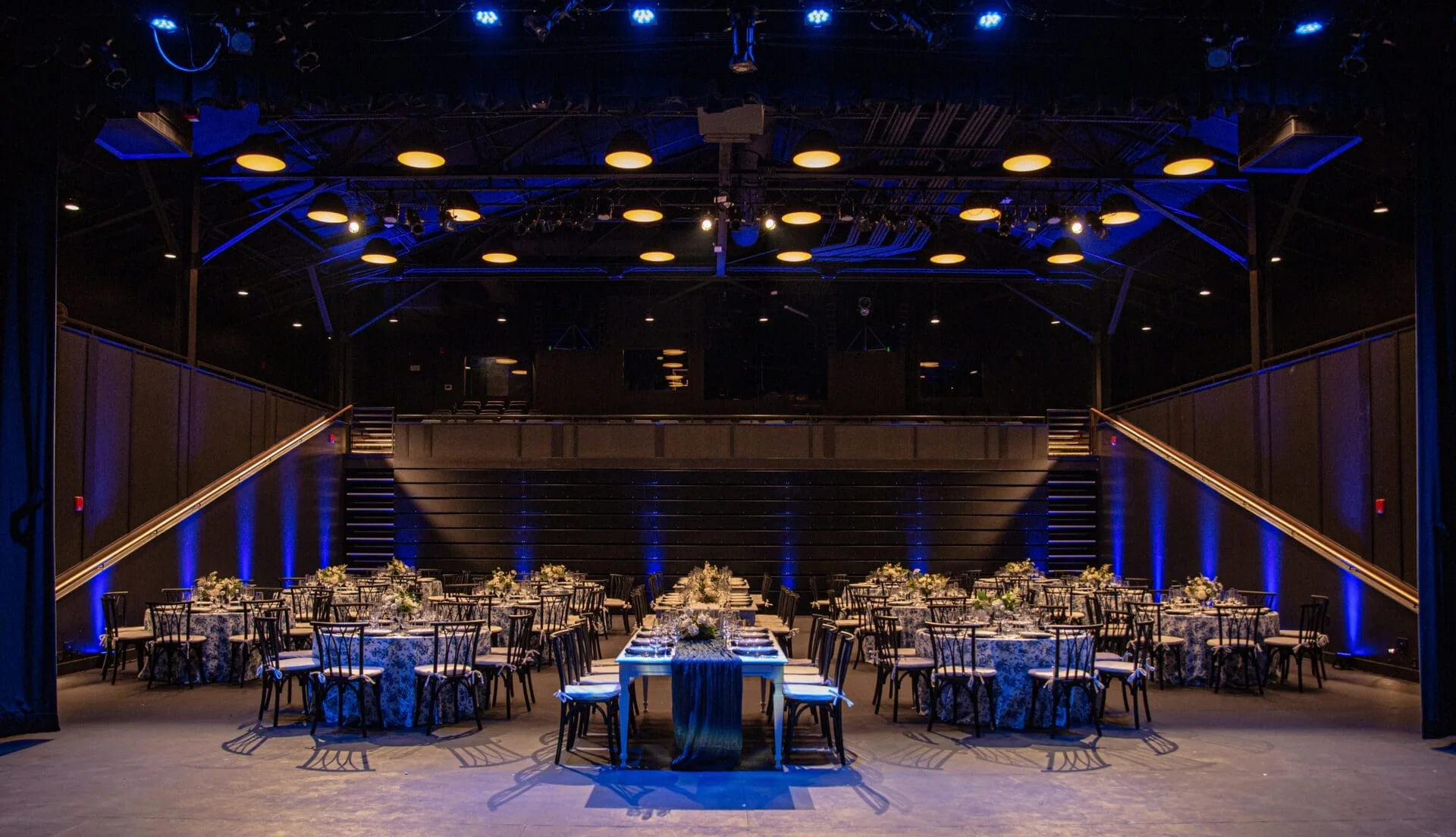
the official venue section says Turner Theater accommodates banquet seating for 300 people.
Useful for Franklin presentations, branded meetings, stage-led events, and smaller-format experiential programs.
Verified venue facts
- The official venue section says Turner Theater accommodates banquet seating for 300 people.
- The same section says the venue includes multiple staging options and kitchen facilities.
- The official section says the venue includes backstage support and minimal wing space.
Execution priorities
- Confirm who owns utilities, rigging, receiving, and event services before vendors are released.
- Keep install, live-show support, and strike in one schedule so the room turns cleanly.
- Use nearby Nashville and Franklin routing only after the building's own timing is understood.
The Turner Theater footprint
Turner Theater accommodates banquet seating for 300 people.
Running a project here means working against the venue's own exhibitor manual, dock windows, and service-order deadlines. Those details are confirmed before any build commits to fabrication.
What drives the Nashville calendar
Scope gets tighter; standards don't.
The venue mix in Nashville ranges from dedicated convention halls to hotel ballrooms and private event spaces. Booth requirements change across that mix — a convention-hall island looks and installs nothing like a hotel-ballroom inline — so the choice of venue drives a lot of downstream scope.
How Nashville floor operations work
Labor in Nashville runs venue-by-venue, not citywide.
Practically, that means pulling the current exhibitor manual for every show and confirming a handful of items in writing: which tasks the venue's house crews cover, which tasks the show's general contractor covers, and what an exhibitor or their appointed contractor can handle without escalation.
Line items on a typical project
The handoffs on a project at the theater matter almost as much as the line items. Design has to hand a build-ready drawing to fabrication. Every handoff is a place quality can drop.
Those run alongside the engagement rather than inside it.
How a project runs
After the brief, the work turns to the building itself.
Install days are owned by a single on-site lead.
Throughout show hours, the on-site lead stays present.
Strike and closeout happen the same day.
Pricing and scheduling
Every project has the same cost drivers.
Lead time drives everything. Custom: 16 to 20 weeks. Rental: 8 to 12.
What a successful project looks like
Most programs in Nashville are evaluated on lead-capture volume, meetings booked on the floor, and qualified-pipeline attribution after the show. The booth is a means to those numbers — it is not the number itself.
A week after the show, the booth's actual floor performance is already clearer than any pre-show projection. We document those observations alongside the technical closeout so the next cycle inherits real signal, not nostalgia.
What makes our work different
Trade Show Services of Nashville keeps the work local.
Consistency across show dates is the other reason to hire local. The same crew that built the booth runs the install, knows the pack-out, and catches the small things — a missing hardware pack, a graphic edge that needs reseating, a storage crate routed to the wrong bay — without needing the client team to intervene.
Frequently asked questions
How much lead time is ideal?
Custom builds run best with 16 to 20 weeks of lead time. Rentals take 8 to 12 weeks.
What information kicks off a project?
The show, the venue, the booth number, the dates, and a target budget range. From those, an initial scope and a realistic cost come back within a few days.
Who runs the booth on-site?
One named show-site lead runs the install, the show hours, and the strike. That person carries the floor plan and the punch list from crates to doors and reports up once a day.
Can the booth travel to the next city on our calendar?
Same structure, swappable graphics, standard crates.
What happens if something breaks during show hours?
The on-site lead handles it.